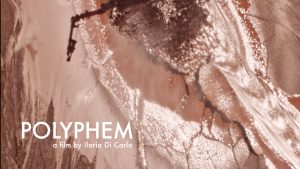
POLYPHEM
Written, Directed & Edited by : Ilaria Di Carlo
Produced by LHOOQ Films
10 Minutes / Experimental Documentary / Germany, Italy (WIP 2026)
Arri Digital / Colour / 2.35:1 / Stereo & 5.1 / ENG
SYNOPSIS
POLYPHEM is the second chapter in a series of short landscape films that reinterpret the stages of the journey of Homer’s Odyssey and set them in the context of the anthropocene. Loosely inspired by the myth of Polyphemus, the film draws on the symbolism of the red colour of bauxite tailings as a metaphor for the wound and threat caused by human intervention.
CREDITS
Director: Ilaria Di Carlo
Produced by LHOOQ Films
Producers: Ilaria Di Carlo, Anne Kutzner, Alexander Kleiber
Director of Photography: Christian Wiege
Music: Giulio Tomei
Editing: Ilaria Di Carlo
Helicopter Pilot: Torben Koopmann
Production Manager: Rebecca Shein
Postproduction Supervisor: Sergi Sanchez Rodriguez
Colour Grading: Andreas Hellmanzik
Re-Recording Mixer: Nico Berthold
Graphic Designer: ANN- Institut für visuelle Freude
FUNDED BY
Nordmedia – Film – und Mediengesellschaft Niedersachsen Bremen mbH
DIRECTOR’S STATEMENT
POLYPHEM is part of a series of short films that reimagine the mythic journey of Homer’s Odyssey within contemporary, man-made landscapes shaped by agriculture, extraction, mining, industry, and mass production. Echoing the ancient myth of the Cyclops, POLYPHEM reflects on violence, on the wound carved into the landscape by the deep, saturated red of bauxite tailings and toxic red mud, a byproduct of aluminium refining, which is both painterly and poisonous. It evokes a lake of blood, a metaphor for environmental scarring and a symbol of our paradoxical relationship with destruction.
Artificial landscapes are not merely altered terrains, they are scars: physical evidence of unsustainable extraction, industrial excess, and capitalist overreach. They possess a brutal grandeur, seducing the gaze while revealing something irreparably broken. This ambivalence between awe and terror, beauty and horror, is central to POLYPHEM’s visual language and artistic research. Here, the sublime is no longer found in untouched nature but in the overwhelming consequences of human activity. The film dwells in this tension: between the aesthetic and the abject, the sacred and the violated, the mythical and the modern.